
Familiar carols eek out of hardware store speakers. Garlands and red streamers coil around doorposts. Flavors of peppermint, cinnamon, and brown sugar adorn seasonal drinks and snacks. Cherished passages from Dickens or scripture are read. It’s Christmas. You can feel it.
Traditions like these and the many more that vary by culture, family, and corner of the world give us the gift of familiarity. Traditions act like a preservative—protecting familiar feelings and truths, keeping them alive for generations. Traditions teach us what to expect. We come to rely on them for a sense of normalcy.
That’s what makes Christmas traditions ironic by nature. At the heart of Christmas’ celebrations is a single event in which every sense of “normal” or “familiar” was utterly destroyed. God became man. The Supreme Creator humbled himself to be born into a family of oppressed Jews living beneath the poverty line.
The opening words of John’s Gospel simply do not allow us to treat Christmas like another familiar tradition. In the first chapter, John does not describe a warm and familiar setting for the baby to be born. From the first verse, he robs us of our tendency to look with adoring eyes on a cute little infant:
“In the beginning was the Word, and the Word was with God, and the Word was God.”
John 1:1
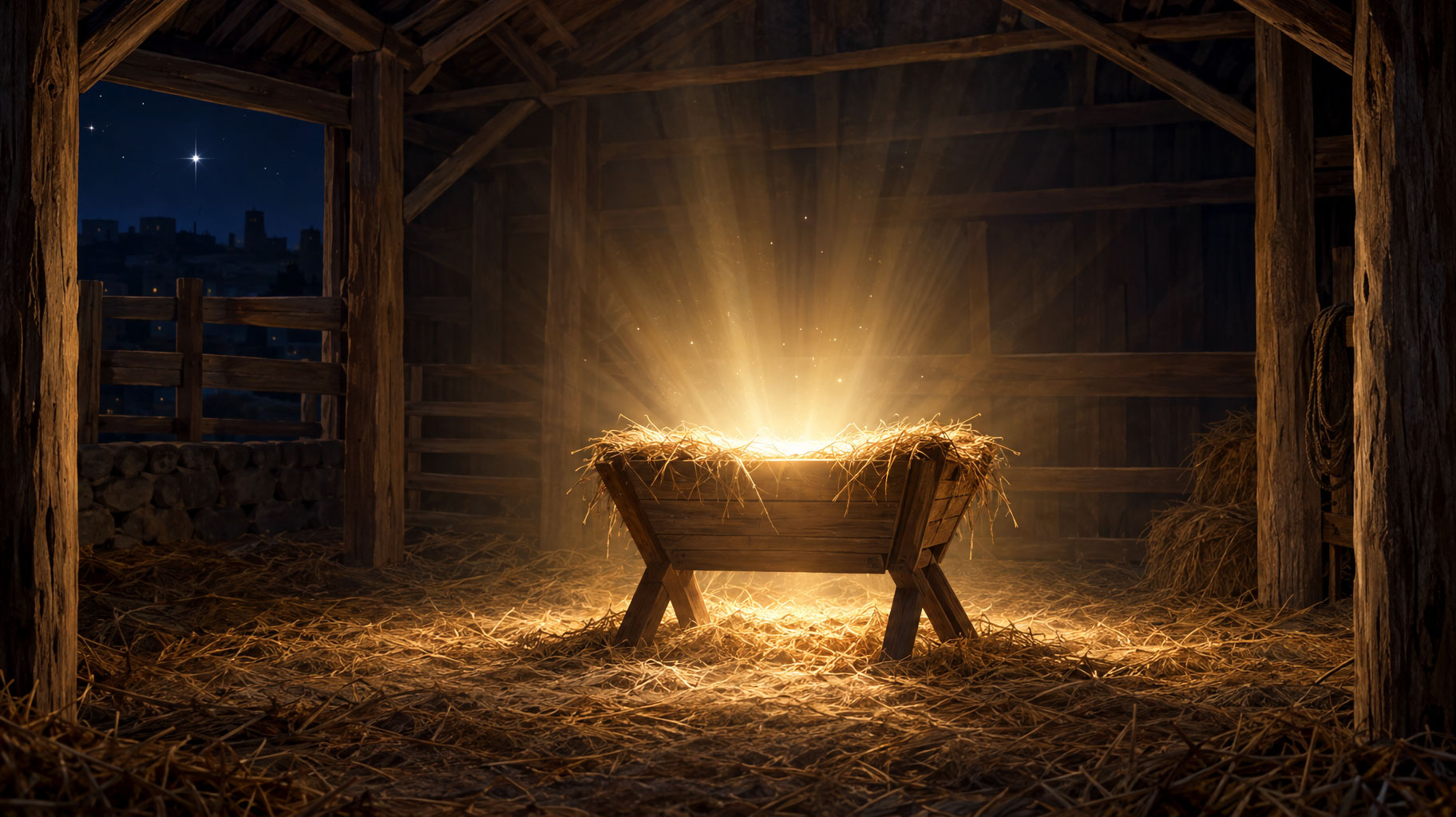
Yes, the baby lying in the feeding trough is God!
Through him we were created (John 1:2). All things good and all things alive owe homage to him (John 1:3).
But ever since Adam and Eve fell, each generation of humans has only shown the pattern of wicked rebellion against our Creator. What is most familiar, most normal to the human heart is darkness and sin (John 1:5). Though we owe him our lives and our homage, we refused to give it (John 1:10-11). The grievous human tradition is to scorn the God who made us and to go our separate way (Isaiah 53:6). Up to this very moment, dear reader, neither you nor I have stopped turning away from him. Sin is the tradition from which we have never been able to break ourselves free. We know it too well. Fights around the Christmas tree. Frenzied hunts for the perfect gift, as if life and love depend on it. Unspoken disgust at our family, friends, or neighbors and their behavior. Cherished secret vices we protect with clever deceit. Celebrations that find more joy in our own reverent service than in the Savior baby. This is familiar to us—comfortable, even! So, when the embodiment of all that is good and holy appears to us, we know him not.
Jesus was born to break traditions. The Supreme Creator humbles himself by taking on flesh to serve his rebellious creation (Philippians 2:6-7). The Light of the World enters our darkness (John 9:5; Colossians 1:13). The Holy Lord comes to save unholy people from their own unholiness—to defy any sense of the normal, the expected, the familiar.
We’d expect God to respond to our rebellion with wrath. Jesus is born to take that wrath upon himself. It would be “normal” if God would cut loose the rebellious creation that scorned him. Jesus draws closer. It would be “normal” if God would turn his back on us for our sin. Jesus comes to reveal what God we actually have: a God of mercy, of grace, and of truth (John 1:17-18).
So, there’s something strange about treating Christmas like a routine. It’s not. Praise God that it’s not! Christmas means we do not get what our sins deserve from God. Christmas means we are not estranged from him—he crossed the chasm from heaven to earth to save us. Christmas means that God comes to us, wants to be ours, and wants us to be his. The Word was made flesh! That stuff doesn’t happen! But it did. And because it did, you now know God as the God of love and mercy, and that his love and mercy are yours forever, in every season.
Scripture Study Tools
Free Access
Enter your email below for immediate access to our entire library of Scripture Study Tools, including printables, phone wallpapers and guided Scripture studies.
Additional Questions You Might Have

Is Jesus a good example for my life?
One of the lesser emphasized biblical truths is that Jesus lived a perfect life, not just to give us an example of a godly life, but also to fulfill all righteousness for us.